
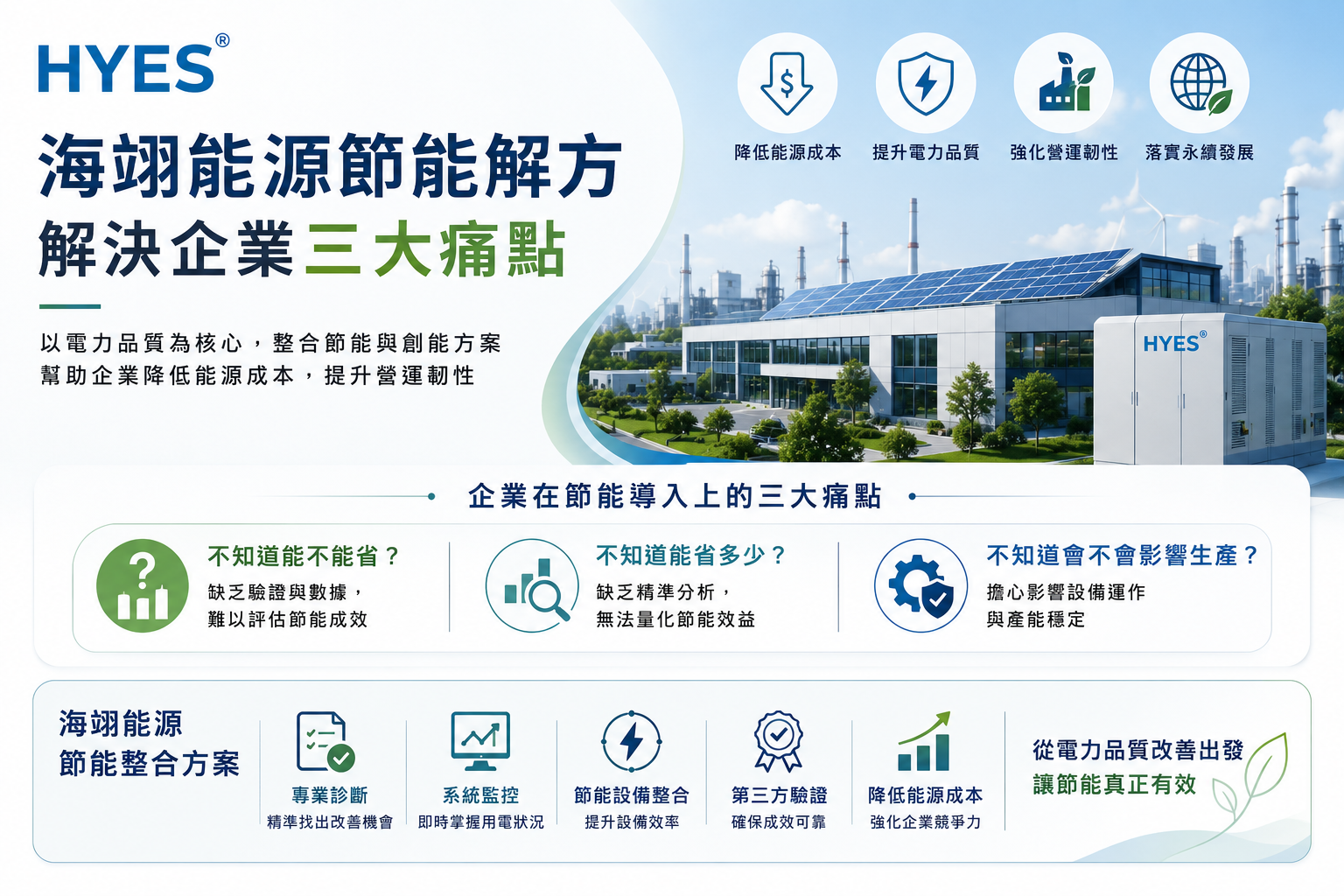
HYES Energy-Saving Solutions: Addressing the Three Major Pain Points of Enterprises
Date: March 11, 2026
Source: Economic Daily News (Reported by WU CHING-CNANG)
As geopolitical tensions in the Middle East drive up crude oil prices and reignite global energy concerns, Taiwanese manufacturers are facing a critical operational turning point. Under the dual pressure of rising electricity costs and accelerating international carbon regulations, the core challenge remains: how to reduce energy expenses without compromising production capacity.
HYES, a specialist in energy technology, has identified three primary hurdles for enterprises adopting energy-saving measures: “Is saving possible?”, “How much can be saved?”, and “Will it affect production?” By launching an integrated solution centered on Power Quality (PQ), HYES has successfully gained traction among major industrial players.
The “Beer Metaphor”: Why Power Factor is Only Part of the Story RUI-DIAN ZHANG, General Manager of HYES, notes that many business owners often ask: “Our factory’s Power Factor (PF) has reached 98%, so why aren’t our electricity bills decreasing?” He explains that while PF is a vital indicator, it is only one piece of the puzzle. The overall Power Quality (PQ) is what truly dictates efficiency.
“I like to use beer as a metaphor,” says RUI-DIAN ZHANG. “The Power Factor is like the foam on a beer—it looks impressive and fills the glass, but it doesn’t quench your thirst. Power Quality is like the alcohol content; it’s the actual substance that determines the ‘strength’ or effectiveness of the energy. No matter how much foam you have, if the alcohol content is low, the beer lacks impact. Similarly, even with a high PF, if your power quality is poor and equipment efficiency is low, your electricity bill will remain high.”
The Gap Between the Meter and the Machine RUI-DIAN ZHANG points to a partner enterprise whose utility bill showed an ideal PF of 98%. However, during on-site verification at the terminal loads, they discovered that the PF of individual systems ranged only from 79% to 88%. This discrepancy indicates that there is significant room for improvement in equipment efficiency and power quality. Crucially, total electricity consumption is the sum of all panels, transformers, and loads across the plant. Even if individual systems show a good PF, the overall energy-saving effect may still be compromised.
A Case Study in Safety: The Hidden Dangers of Compensation RUI-DIAN ZHANG shared a case involving a chemical plant in Southern Taiwan. The plant had installed over 50 capacitor banks, and personnel continued to apply reactive power compensation. This led to overheating and the amplification of harmonics, putting the entire facility in a hazardous state. This case serves as a warning: blindly chasing a high PF without addressing overall power quality is not only ineffective for energy saving but can also jeopardize equipment safety.
Many enterprises use capacitors to boost PF, yet reactive power, harmonics, or surges may still persist within the system, causing equipment to overheat and efficiency to drop. “True energy saving must take a holistic system-wide approach,” concludes RUI-DIAN ZHANG. “By improving terminal equipment efficiency, reducing reactive power, and stabilizing power quality, we can achieve real reductions in electricity bills and total energy costs.”
Source Links: https://money.udn.com/money/story/5722/9340718