
HYES Chairman KAI-YI CHANG: Stable Power Quality Is the Key to Real Energy Savings
Date: August 04, 2026
Source: Economic Daily News (Reported by WU CHING-CNANG)
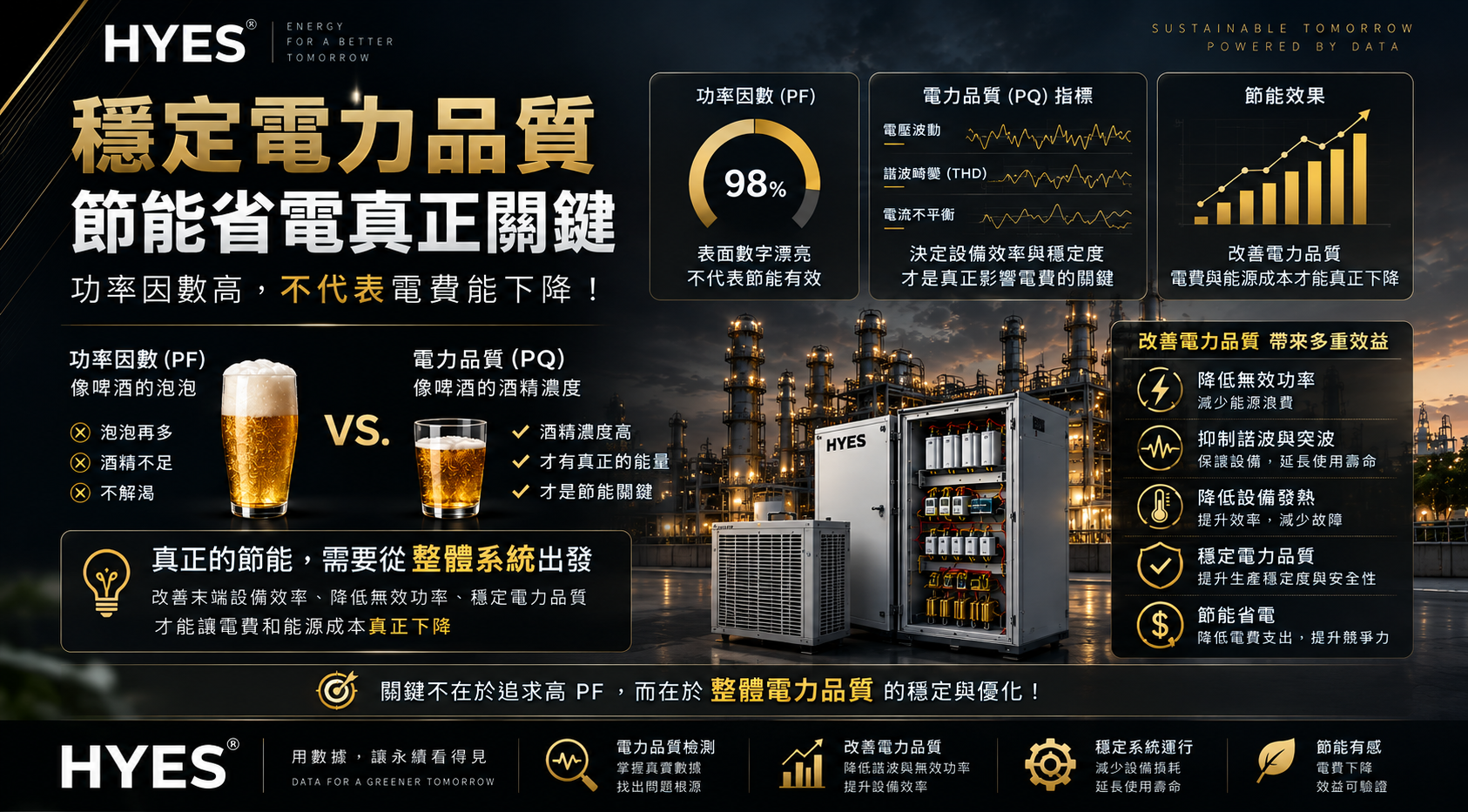
KAI-YI CHANG, Chairman of HaiYi Energy Solutions (HYES), often hears business owners ask, “Our factory’s power factor has already reached 98%. Why haven’t our electricity costs gone down?” The answer is that the Power Factor (PF) is only one indicator of electrical performance. What matters even more is the overall Power Quality (PQ).
KAI-YI CHANG compares it to drinking beer. The power factor is like the amount of foam on a glass of beer—it may look impressive, but it does not quench your thirst. Power quality, on the other hand, is like the alcohol content, which truly determines the beer’s value. No matter how much foam there is, the beer feels weak if the alcohol content is low. Likewise, even with a high power factor, poor power quality reduces equipment efficiency and limits energy-saving results.
For example, one company working with HYES showed a power factor of 98% on its electricity bill, which appeared excellent. However, during on-site energy verification at the load side, HYES found that the power factor of different systems actually ranged from 79% to 88%, indicating room for improvement in equipment efficiency and power quality. More importantly, electricity consumption is calculated from the combined usage of all switchboards, transformers, and electrical loads throughout the facility. Even if individual systems have a high PF, the overall energy-saving performance of the plant may still be compromised.
KAI-YI CHANG also shared another case involving a chemical plant in southern Taiwan. The plant had installed more than 50 capacitor banks, yet operators continued adding power factor compensation based on routine practice. This resulted in overheating and amplified harmonic distortion, placing the entire facility in a potentially hazardous condition. The case demonstrates that simply pursuing a higher PF without improving overall power quality not only fails to save energy but may also threaten equipment safety.
Many companies use capacitors to increase their power factor, yet ineffective power, harmonics, and voltage surges may still exist within the electrical system. These issues generate excessive heat, reduce equipment efficiency, and prevent meaningful reductions in electricity costs. HYES believes that genuine energy efficiency begins with optimizing the entire electrical system—improving end-use equipment efficiency, reducing ineffective power, and maintaining stable power quality—to achieve sustainable reductions in both electricity consumption and operating costs.
Source Links: https://money.udn.com/money/story/5635/9668996