
Facing the 2028 Energy-Saving Compliance Deadline: HYES Introduces “Sustainable Energy Governance Solution” to Help Enterprises Achieve Zero-CAPEX Seamless Transformation
Date: July 22, 2026
Source: Economic Daily News (Reported by WU CHING-CNANG)
With the official launch of the government’s Deep Energy Saving Action Plan, the legal deadline to submit a 5-year energy-saving plan by Q1 2028 is rapidly approaching. In an era marked by both energy transition and power tariff adjustments, precisely optimizing every kilowatt-hour of electricity has become critical for corporate sustainability.
However, many business owners remain stuck in the traditional mindset of “replacing hardware as soon as equipment consumes too much energy,” overlooking the need to fundamentally transform their energy health. KAI-YI CHANG, Chairman of HYES (HaiYi Energy Solutions), points out: “There are no miracles in energy efficiency—only accumulation.” Energy governance is not a one-off equipment purchase; it requires continuous micro-optimizations and long-term accumulation to ultimately transform into a company’s most resilient green competitive asset.
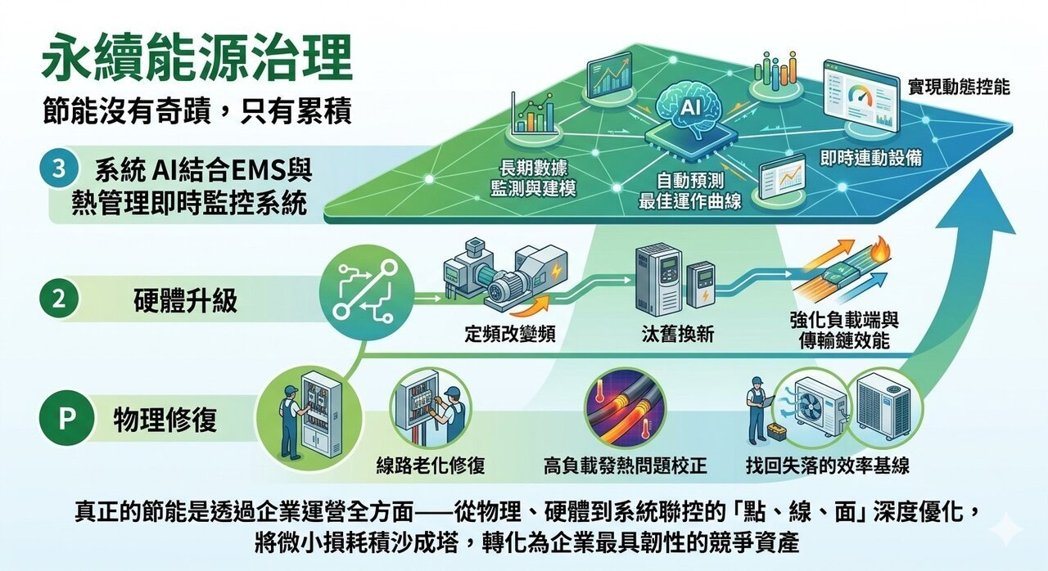
To help Taiwanese enterprises cross the transformation threshold without friction, HYES presents its “Sustainable Energy Governance Solution,” integrating complex factory energy savings into three progressive steps:
Step 1: Physical Repair at the Base Layer to Eliminate Energy Blind Spots
When driving transformation, enterprises are often eager to collect Big Data while ignoring energy blind spots caused by aging equipment and line impedance. HYES starts by building a healthy physical operational foundation. Adhering strictly to regulations such as the Occupational Safety and Health Act as the highest standard, HYES assists enterprises with on-site physical repairs and improvements for power distribution systems, terminals, and heavy electromechanical equipment. By introducing patented water-soluble polymer composite materials, HYES precisely eliminates contact impedance at distribution panels and contact points across the plant, mitigating abnormal temperature rises and reactive power losses caused by high currents.
In a practical case study involving a landmark department store in Taichung, its main and outdoor plaza distribution boxes were long exposed to extreme heat and urban heat island effects. Thermal imaging revealed that the conductors and terminals were overheating with severe thermal loss due to high currents. Restricted by BOT contract terms and property rights, the client could not directly replace existing large electromechanical equipment. Leveraging government subsidy regulations and energy-saving frameworks, HYES implemented base-layer physical governance using composite materials, combined with external heavy-duty VFD (Variable Frequency Drive) equipment and AI HVAC technology. Without replacing primary equipment or interrupting operations, HYES successfully reduced contact impedance and excessive temperatures, establishing a clean and highly efficient foundation for equipment operation.
Step 2: Hardware Inverter Upgrades for Dynamic Regulation
Traditional fixed-frequency equipment operates on fixed output modes, creating massive energy blind spots when facing rapidly changing on-site demands. HYES assists enterprises in adopting high-quality heavy-duty VFD retrofits, allowing equipment to dynamically adjust frequency and speed based on real-time loads. Through this upgrade, machinery operates according to actual demand, avoiding prolonged full-load operations while transmitting real-time operational data to the data hub, laying the foundation for smart control.
Step 3: AI Smart Joint Control and IPMVP Scientific Verification
Current government industrial subsidy programs (such as TIIP, A+, and AI Resilience Transformation Projects) now place 100% emphasis on the integration of AI technology. HYES advances systems into smart joint control domains, including AI HVAC and AI compressed air systems. Addressing client queries regarding energy-saving rates driven by AI Agents, HYES emphasizes: “Energy efficiency is not a miracle; it is a rigorous math problem.” The amount of electricity saved depends entirely on the extent of control authority and how precisely high-energy equipment can be optimized and dispatched.
To this end, the solution strictly adheres to IPMVP (International Performance Measurement and Verification Protocol) standards, rejecting ambiguity and fully implementing scientific data management. By transforming previously unquantifiable energy losses into transparent, traceable scientific metrics, HYES not only helps enterprises grasp tangible carbon and electricity reduction achievements, but also lays a rock-solid foundation of data verification and asset resilience for ESG green transformation ahead of the 2028 compliance deadline.
Source Links: https://money.udn.com/money/story/5635/9640571