
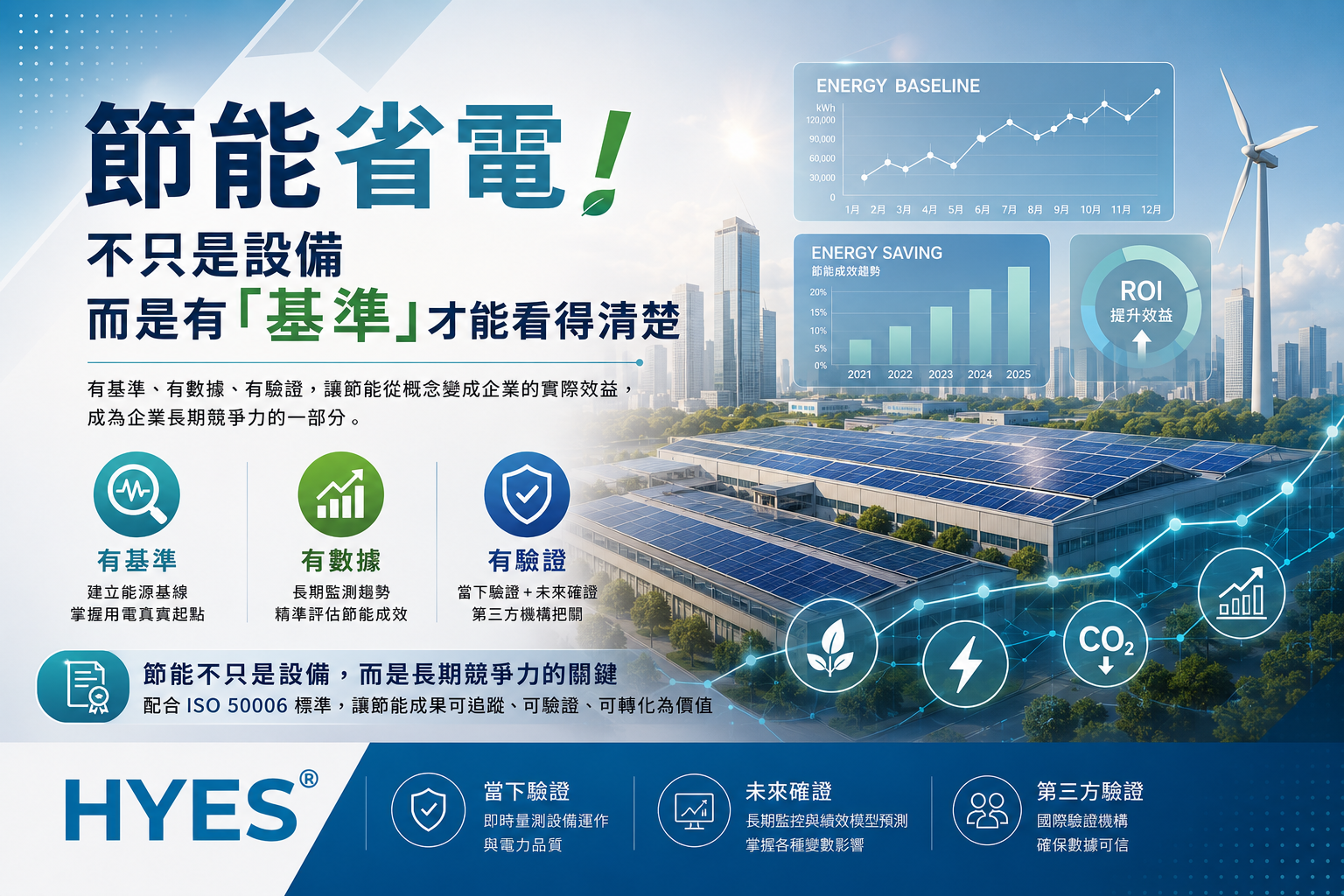
Energy Efficiency Redefined: It’s Not Just Equipment—Only with a “Baseline” Can Success Be Clearly Measured
Date: February 24, 2026
Source: Economic Daily News (Reported by WU CHING-CNANG)
KAI-YI CHANG, Chairman of HYES, notes that when evaluating energy-saving solutions, most enterprises prioritize “Payback Period” and “ROI (Return on Investment).” While these figures may seem straightforward, KAI-YI CHANG often reminds clients: “No matter how attractive the numbers look, without a reliable Energy Baseline, they remain nothing more than a theoretical exercise.” Even the most advanced equipment cannot provide precise long-term savings data without a dependable benchmark; in such cases, ROI serves only as a rough estimate.
The Energy Baseline: The “True Starting Point” of Corporate Power Consumption The energy baseline represents the actual starting point of an enterprise’s electricity usage, encompassing power quality factors such as voltage, current, power, and harmonics. In the short term, power analyzers can be used to measure data before and after improvements to confirm if equipment is functioning correctly and if power quality has improved—much like a medical check-up for machinery.
However, an effective energy-saving baseline is not merely a snapshot; it is a long-term trend and a forecast of future power consumption. If a factory increases production during peak seasons or if electricity tariff structures change, the estimated payback period may lengthen. Without long-term monitoring and trend analysis, there is often a significant discrepancy between estimated energy savings and actual results.
Case Study: Seasonal Variations in Long-Term Monitoring HYES previously collaborated with a client in an industry that relies heavily on refrigeration equipment. Through long-term trend monitoring of the energy baseline, it was discovered that energy-saving effectiveness varied by as much as 2% to 3% between summer and non-summer months. Just as corporate electricity bills fluctuate, HYES advises clients to implement baseline monitoring and evaluate energy-saving performance on an annual basis to truly grasp the long-term value provided by the equipment.
“Immediate Validation” and “Future Confirmation” To provide peace of mind for enterprises, HYES employs a dual-verification approach:
- Immediate Validation: Real-time measurement of power quality and equipment operation to ensure optimal performance.
- Future Confirmation: Establishing long-term energy monitoring and performance models to simulate energy-saving effects under varying production capacities and electricity rates.
HYES also collaborates with international third-party verification agencies to ensure that all data is credible and transparent. This ensures that energy saving is not just about equipment running well, but about achieving real, quantifiable results.
By adhering to the ISO 50006 standard, an enterprise’s energy-saving achievements become traceable, supporting ESG goals and carbon reduction commitments. Ultimately, the core of energy efficiency is not about how much hardware is purchased; it is about having “a baseline, data, and verification.” This transforms energy saving from a mere concept into a tangible corporate asset and a core component of long-term competitiveness.
Source Links: https://money.udn.com/money/story/5722/9340718