
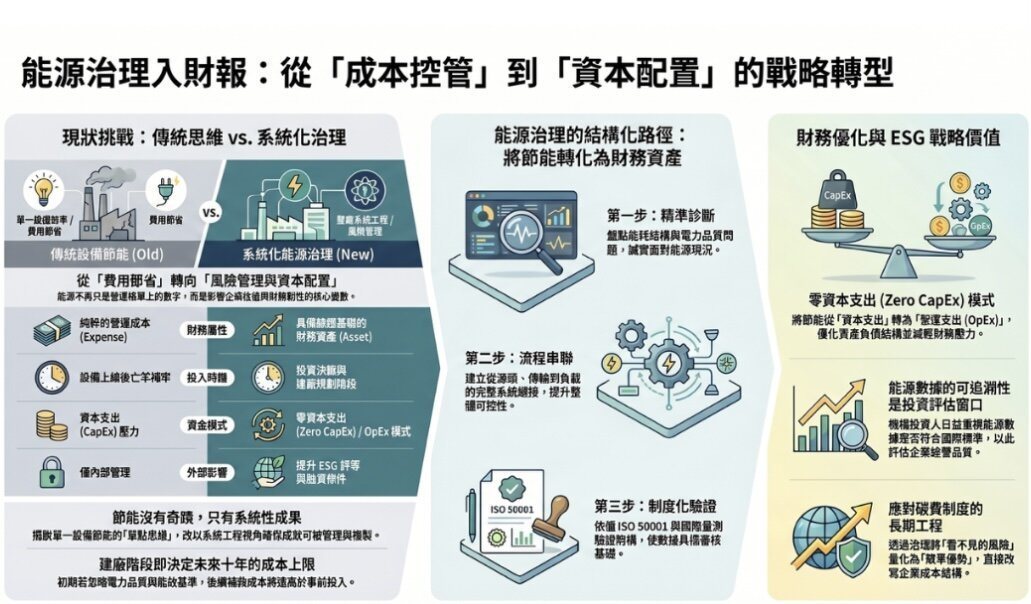
Strategic Transformation of Energy Governance in Financial Reporting: From Cost Control to Capital Allocation
Date: May 18, 2026
Source: Economic Daily News (Reported by WU CHING-CNANG)
As carbon pricing mechanisms and ESG disclosure requirements continue to take shape globally, energy management is no longer viewed solely as an operational expense. It has become a critical factor influencing corporate valuation, financing capability, and long-term cash flow stability. According to KAI-YI CHANG, Chairman of HYES, the role of energy management is fundamentally shifting from “cost reduction” toward “risk management and strategic capital allocation.”
Despite this shift, many enterprises still rely on equipment-oriented approaches, expecting a single technology to deliver meaningful energy savings. Without systematic integration and measurable verification, such models are difficult to sustain financially and rarely produce long-term value. In practice, energy efficiency is not driven by isolated breakthroughs, but by systematic methodologies that can be managed, optimized, and replicated.
Drawing from years of experience in high-tech manufacturing and plant construction, KAI-YI CHANG emphasizes that energy challenges are never limited to individual technologies; they are extensions of overall plant system engineering. Decisions regarding energy infrastructure during the construction phase often determine the operational cost ceiling for the next decade. When power quality, load distribution, and efficiency benchmarks are overlooked during early-stage planning, the cost of later corrections can significantly exceed the original investment. This is why energy governance must be integrated into investment planning from the beginning, rather than addressed only after systems are deployed.
KAI-YI CHANG further notes that the true value of energy governance lies not in the efficiency of individual equipment, but in the controllability, transparency, and verifiability of the entire system. To convert energy-saving performance into tangible financial assets, enterprises must establish a structured framework: accurately diagnosing energy consumption patterns and power quality issues, integrating processes from energy sources to transmission and load management, and institutionalizing operations in accordance with ISO 50001 and international Measurement & Verification (M&V) standards. Only when data becomes verifiable can energy efficiency meaningfully enter the financial statement.
As ESG disclosure standards become increasingly stringent, institutional investors are placing greater emphasis on the traceability of energy data and compliance with international measurement standards. The energy section within ESG reports is rapidly becoming a key indicator of operational quality and financial resilience. Energy governance is no longer simply an internal operational tool; it is becoming a strategic language for communicating corporate resilience and sustainability to the capital market.
To overcome the financial barriers associated with transformation, the Zero CapEx model provides an alternative pathway that allows enterprises to initiate energy governance without upfront capital investment. By transforming energy initiatives from Capital Expenditure (CapEx) into performance-linked Operating Expenditure (OpEx), companies can optimize balance sheet structures while maintaining financial flexibility. For capital-intensive high-tech manufacturers, adopting an OpEx-driven energy governance model not only reduces financial pressure but also contributes to stronger return on equity (ROE).
As carbon fee systems continue to evolve, energy governance will directly reshape corporate cost structures and competitive positioning. This is no longer a short-term efficiency project, but a long-term operational strategy aimed at transforming invisible risks into measurable competitive advantages. And in many cases, it begins with a single step: an honest assessment of a company’s energy consumption structure.
Source Links: https://money.udn.com/money/story/5722/9509403